
Cashew nuts, marañon, may have been introduced from Brazil
I am not familiar with any painting or 3-dimensional representation of cashew fruits or nut in pre-Columbian art, but nothing would surprise me (and perhaps such pre-Columbian representation exists and I missed it). So the cashew nut is not of iconographic or religious interest, but is a food plant for centuries.
I am not familiar with the cashew being prominently mentioned in ethno-historical sources (Landa, etc). So I would need to ask a botanist when the cashew tree arrived in Mesoamerica. Most of the cashew nuts you get in cocktail parties around the world come from plantations in Asia, but the origin of this tree is tropical America, specifically Brazil.
But… what if cashew tree wood was found in pre-Columbian Honduras?
In an unusual discovery, the wood of cashew (Anacardium cf. occidentale) was found in Middle Formative contexts at the Yarumela Site, Honduras.
- 1997
- Formative-Period Subsistence and Forest-Product Extraction at the Yarumela Site, Honduras. Ancient Mesoamerica 8:63-74 Cambridge University Press
Introduction to cashew nuts, marañon,Anacardium occidentale
At any cocktail party I can find the bowl of mixed nuts and pull out all the cashew nuts pretty quickly, and gobble them down. Yes, I like other nuts, but cashew are by far my favorites.
I will admit I have no idea why I like them, or whether they are more healthy than the other nuts in the mixed-nut tray. I do know that the cashew nut is slightly toxic until heated. But by the time you get the cashew nuts they have been treated: even the ones you can buy on the streets of Mexico and Guatemala.
The cashew "nut" is not inside a shell. The cashew nut is a growth outside, at the end of a soft fruit.
The cashew nut is not only poisonous, the tree is related to poison sumac, poison oak, and poison ivy. The family is Anacardiaceae. But don't worry, the cashew is treated (with heat) before being served to you. I have been eating cashew nuts for decades and am very healthy. But if you are allergic to peanuts, stay away from cashew nuts (especially for children).
The chemicals surrounding the nut are evidently not a problem in the soft fruit above the hard nut chamber.
The plant, cashew tree, Anacardium occidentale
The tree can be up to 10 m tall. Its leaves are kind of leathery. The delicate flowers may be white with red spots or stripes (8 mm long). The fruit varies somewhat in size, shape and especially in colors: yellow through red.
In theory it blooms from February to March and fruiting from April. But since the different elevations have different sunlight and rainfall amounts, the blooming may vary by eco-system. And our experience is that blooming and fruiting vary by the year (since cloud cover and rain vary by year in addition to being different for each eco-system).
The cashew tree is naturalized throughout the Neotropical and tropical parts of the world. The big plantations are in India. In Guatemala you can find the tree from sea level to 1800 m, most commonly in the departments of the piedmont (boca costa).
When the bark is removed a rubber-like latex exudes, that has been used as a glue or to varnish objects.
The gum is used as a folk medicine to cure warts. The juice of the seed is indelible and has been used by many indigenous groups to write and a black dye (Duke 1983 and 1989).
Tannin (to cure leather) can be extracted from around the nut.
The bibliography for this web page on cashew is in our bibliography web site, www.maya-art-books.org.
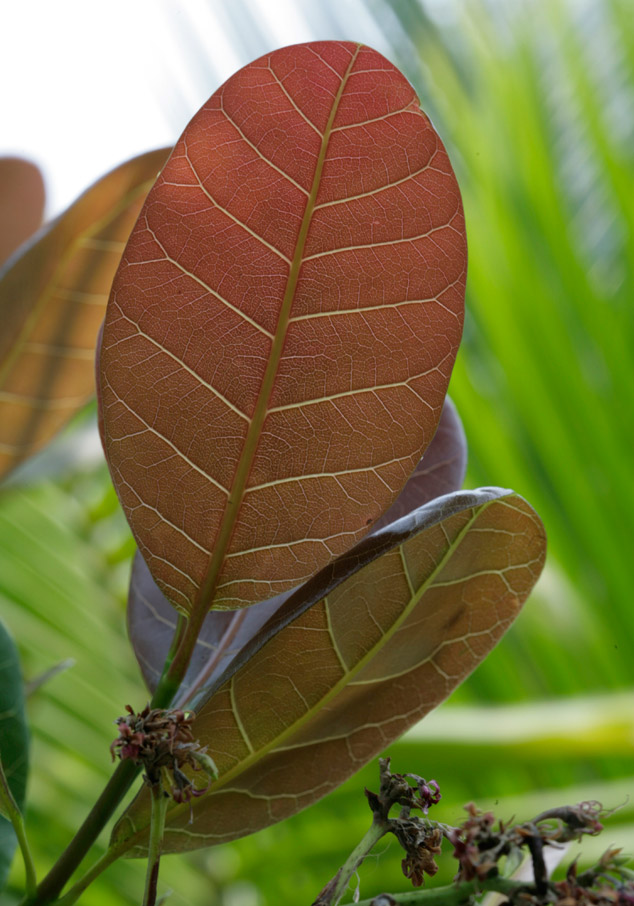
Cashew leaves, notice the leathery texture, characteristic of this tree, FLAAR archive, photo by Nicholas Hellmuth.
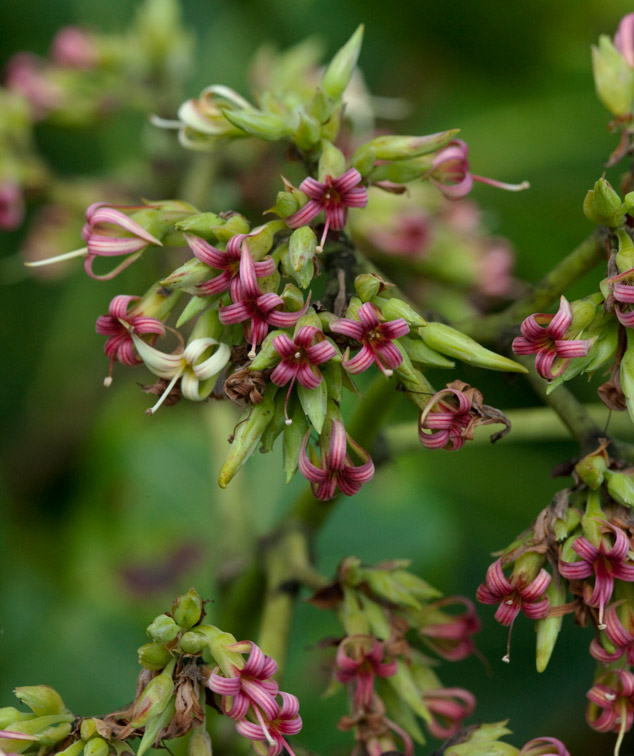
Cashew flowers at Monterrico, notice the white stripes of the flower, FLAAR archive photo by Nicholas Hellmuth.
Where can you see cashew trees (marañon) growing?
These nuts are grown in Alta Verapaz as well as near Guatemala City. So even if outside it's natural habitat, cashew grows at close to 1000 meters elevation if transplanted to a garden. So botanical descriptions might be modified to allow this plant's range to be more realistic.
I would estimate they can be grown in Peten and any lowland area as well. They probably require more sun than they would get in my garden in Guatemala City (since I have many very tall bananas and tall heliconia that shade everything).
I have also seen cashew growing in Chocola area, Suchitepquez. This is an area of cacao and countless other edible plants. You would expect cashew in many parts of Belize and adjacent Mexico. Most of the tourist-oriented web sites that discuss Belize mention that a cashew wine is made. I have not noticed this as much in other parts of Mesoamerica but I must admit I am content with wine from grapes, and for cashews, I prefer it as a nut and not as a wine.
Cashew fruits come in red and yellowish varieties. If I remember correctly I tend to see the yellowish varieties in Guatemala.
The nut develops first, so you can find nearly full-sized nuts at the end of tiny infant fruits. Then the fruit develops: green at first. The final color comes only when it matures and ripens.
The flowers are attractive but very small.
If you are a tourist and want to see cashew trees, Belize seems to have added a clever focus on the cashew to provide this experience to tourists, more than than Guatemala or Mexico. But if you simply wish to munch on cashew nuts, you can find them in almost every native market throughout Guatemala and in many areas of Mexico and Honduras. Often street vendors sell them in plastic bags.
It is interesting that bats may be the dispersal agent for the cashew.
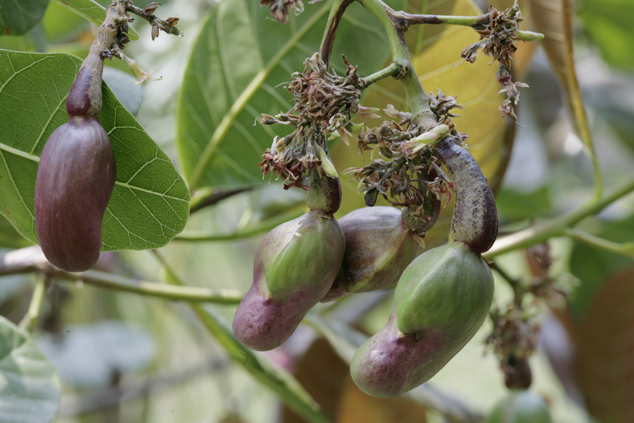
Plantation of cashew, FLAAR archive, photo by Nicholas Hellmuth
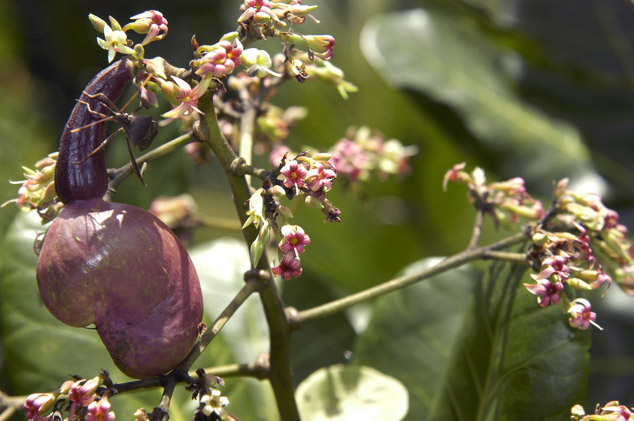
Cashew nut and fruit growing, FLAAR archive, photo by Nicholas Hellmuth
Edible parts
You can eat the nut, the fruit, and the oil. The fruit rots quickly and so you will never find this in supermarkets; at best in a native market for immediately consumption. The fruit would not likely withstand shipping internationally, unless processed into a finished food product such as juice. Pepsi Co. is experimenting making a cashew apple juice drink under the Tropicana brand (New York Times, August 2014).
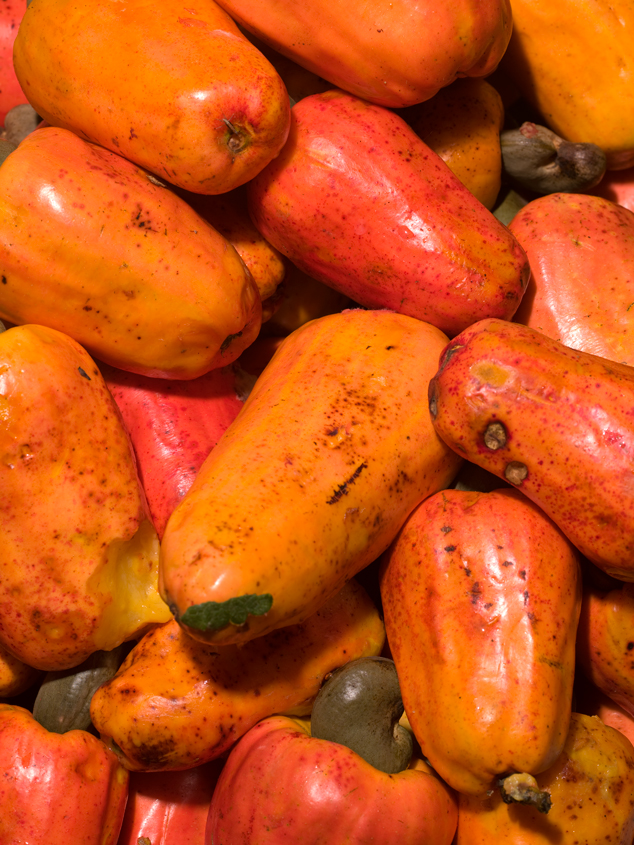
Cashew fruit as can be found in local markets
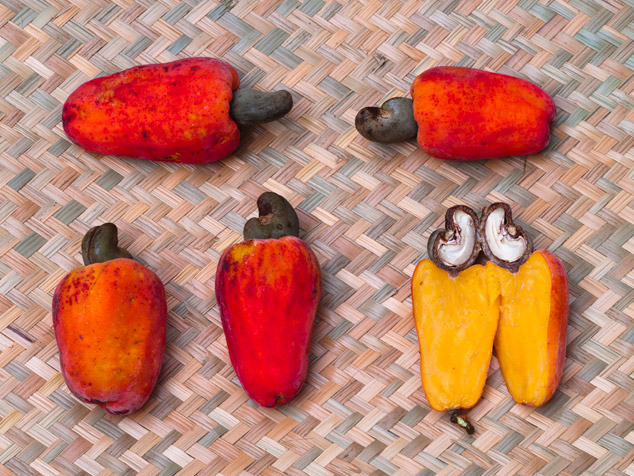
Cashew fruit and nut, notice the beautiful colors inside and outside
Thesis or dissertation potential on cashew trees
Cashew is more of a major cash crop today than a study for Mayan archaeology. But there is plenty of potential for cashew nuts on the world market, so probably a better thesis for a botanist than for an archaeologist. What needs to be studied is whether the cashew was present in the Maya areas before the arrival of the Spanish.
Yes Mayanists need to know that the “origin” of the tree 10,000 years ago was in Brazil. But to us what counts even more is when did it arrive in Mesoamerica, and associated with which cultures (or was it already here so long ago that the first arrivals would have found it already growing in Mexico, Belize, Guatemala, Honduras, and El Salvador?
A good start would be to see if there are native Mayan words for cashew tree and its parts in the Q’eqchi’, Peten Ytza, Mopan, Chorti, and other pertinent Mayan languages.
Helpful basic information is readily available
The Centre for Underutilized Crops, University of Southhampton, UK, has a nice description of cashew nut and plant. Has drawing, a few photos, and good basic information. Short but to the point so you don't wander around lost in stuff you don't want to learn about.
We have a more complete bibliography on cashew nuts, cashew apples, and cashew trees on our bibliography web site: www.maya-art-books.org.
This book below has a chapter on cashew nuts.
ROSENGARTEN, F.
1984The Book of Edible Nuts, Walker and Co New York.
http://edis.ifas.ufl.edu/hs291
http://ww.pavuc.soton.ac.uk/fruits/fruits_factsheets/Factsheet_4_Cashewapple_final_3006.pdf
Shows the fruit as bright red. I have rarely seen a fruit completely tomato-red.
http://www.fao.org/docrep/X5043E/x5043E06.htm
http://fiveprime.org/hivemind/Tags/anacardium/Interesting
best photos of cashew nuts and fruits
Gallery
{vsig}mr-Gallery{/vsig}
Most recently updated August 14, 2014 after reading an article in the New York Times which was handed out on the Turkish Air flight from Tehran to Istanbul a few days previously. I had been invited to Iran by wide-format inkjet printer people to give a lecture series for them. They knew of my interest in archaeology and architectural history of the Middle East, since that was a subject I studied while a student at Harvard
Most recently updated August 14, 2014
Updated June 27, 2016
First posted July 07, 2011